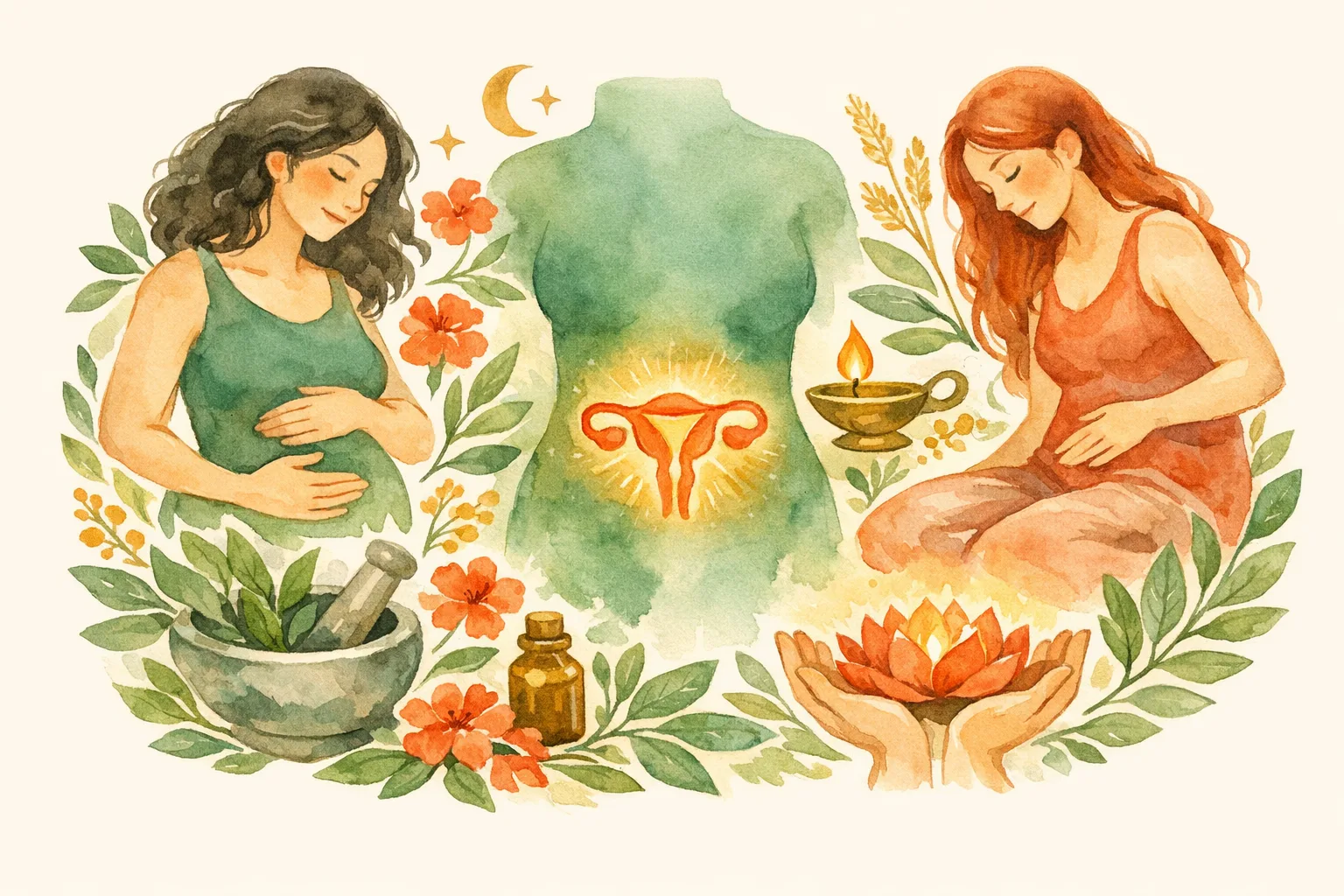
Your Womb Is Not Broken
You have been told your numbers are bad. Your lining is thin. Your hormones are off. A doctor handed you a protocol and a price tag. And you are sitting there wondering if your body can actually do this.
What most fertility clinics skip: the uterus is a living, responsive organ. It changes based on stress levels, blood flow, hormone signals, diet, and sleep.
This article walks through what the research actually shows about uterine health, what disrupts it, what restores it, and where Ayurveda has measurable data behind it.
What Womb Wellness Actually Means
The term sounds soft. The research behind it does not. Womb wellness is about the functional state of the uterus as a site for implantation and early pregnancy. Three things matter most.
First, endometrial thickness. Research published in GREM Journal found that a lining of 10-11 mm is a predictive threshold for achieving pregnancy. Thinner than that, and implantation becomes unreliable.
Second, receptivity. The uterus has a short window each cycle when it will accept an embryo. Disruptions to that window - from hormonal imbalance, inflammation, or stress - are a major cause of failed IVF cycles and unexplained infertility.
Blood flow is the third factor. The uterus needs a steady oxygen-rich blood supply. Poor circulation degrades tissue quality, and poor tissue quality means poor outcomes, with or without medical intervention.

What Disrupts Uterine Health
The four main disruptors are stress, poor diet, hormonal imbalance, and undiagnosed conditions like endometriosis or fibroids.
Stress Is a Uterine Issue
A study published in Communications Biology (PubMed ID: 35982177) found that women with pregnancy loss or infertility had significantly higher stress hormone levels in their blood, and that excessive stress hormone levels disrupted the normal function of endometrial tissue during the implantation phase.
A separate study published in Scientific Reports found that elevated cortisol inside the uterine lining was associated with changes in 182 genes involved in embryo implantation and early pregnancy. Chronic stress rewrites the uterus at the genetic level.
Research published in GREM Journal also found that women under chronic stress had a measurably thinner uterine lining compared to women with lower stress levels.
Fibroids, Endometriosis, and PCOS
According to the National Institutes of Health, up to 80% of women may develop uterine fibroids by age 50. Endometriosis affects roughly 10% of women overall, but 30-40% of women who struggle with infertility. Both conditions alter the uterine environment for implantation.
Polycystic ovary syndrome disrupts the hormonal signals the uterus depends on to prepare its lining each cycle.
What the Research Shows
IVF and the Uterus
IVF works on embryos. It does not fix the uterine environment. For women with low ovarian reserve, a PLOS One study tracking 769 cycles found a cumulative success rate of just 20% after five to six full IVF cycles. Each cycle costs between $19,000 and $30,000. That adds up to $100,000-$180,000 for a 20% chance.
Only 25% of Americans have any IVF insurance coverage. And 35% of couples quit IVF before completing enough cycles to have a real statistical chance - not because the treatment stopped working, but because the emotional and physical toll became too high.
Natural Conception After an IVF Recommendation
Between 17% and 24% of couples told they need IVF go on to conceive naturally without any medical intervention. That means roughly one in five couples who receive an IVF recommendation did not biologically need it.
There is a window in which addressing uterine health, hormonal balance, and lifestyle factors can lead to natural conception - a window that many couples are not given time to explore before being pushed into a clinical protocol.
Holistic Approaches and Fertility Outcomes
A systematic review published in PMC (PMC11073818) analyzed clinical studies on Ayurvedic management of infertility across PubMed and Scopus databases. The review found that Ayurvedic management showed promise as a cost-effective approach for addressing infertility disorders and also enhanced IVF success rates in patients who had previously failed IVF cycles.
An Inito study tracking women with low ovarian reserve who received targeted holistic Ayurvedic support found that 84% conceived within 12 cycles. Compare that directly to the PLOS One figure of 20% cumulative IVF success over five to six cycles for the same patient group.
Two small studies suggest stronger outcomes with Ayurvedic support for this subgroup. Larger randomized controlled trials are needed to confirm these findings at scale.
A cross-sectional survey published in PMC (PMC10394890) of 1,460 fertility patients at a major academic center in Chicago found that more than 80% were already using at least one form of integrative medicine alongside their fertility care. The most common choices were acupuncture, yoga, and massage.

The Ayurvedic Approach to Womb Wellness
Ayurveda approaches the uterus through a framework called Kshetra - meaning the field. The idea is that a healthy seed cannot grow in depleted soil. The uterus must be prepared before conception can happen. The minimum preparation period is three months. The ideal period is twelve months.
Shatavari - The Most Studied Herb for Female Reproductive Health
Shatavari (Asparagus racemosus) is the most researched Ayurvedic herb for female reproductive health. A randomized, double-blind, placebo-controlled trial published on PubMed (PMID: 40434025) tested a standardized Shatavari root extract in 50 perimenopausal women over 120 days. The results showed a 56.3% reduction in follicle-stimulating hormone and a 188.1% increase in anti-Mullerian hormone levels compared to placebo, with no adverse events reported.
A second randomized, double-blind, placebo-controlled trial published on PubMed (PMID: 41209045) found that Shatavari root extract was an effective and safe natural intervention for perimenopausal hormonal symptoms. The combination of Shatavari with Ashwagandha showed additional benefits for stress and mood markers.
Both studies focused on perimenopausal women. Direct evidence for Shatavari in actively cycling fertility patients requires more and larger trials.
Ashwagandha for Stress and Hormonal Balance
A review published in PMC (PMC10981444) examined Ayurvedic herbs including Ashwagandha (Withania somnifera) for female reproductive health. Ashwagandha is documented as an adaptogenic herb that helps the body manage chronic stress. Its active compounds are recognized as precursors to fertility hormones and are documented to stimulate blood flow to reproductive organs.
Triphala for Uterine Detox
Triphala is a combination of three fruits - baheda, amla, and haritaki. According to research reviewed at Ferty9 Fertility Center, Triphala is recognized in Ayurvedic practice as a support for uterine cleansing, hormone regulation, and female fertility. It may also help remove obstructions in the fallopian tubes. Human clinical trials are limited.
Panchakarma - The Cleansing Protocol
In Ayurveda, womb wellness begins with purification before supplementation. The purification system - called Panchakarma - includes procedures such as Virechana (therapeutic purgation) and Basti (therapeutic enema). A case report published in PMC (PMC10828798) documented a 32-year-old woman with endometriosis who had already failed IVF, IUI, and hormonal therapy. After five months of Ayurvedic treatment including Virechana and Uttarabasti, she conceived and delivered a full-term baby. This is a single case report. It cannot be generalized.
Comparison Table - IVF vs Ayurvedic Protocol for Uterine Health
| Factor | IVF | Ayurvedic Protocol |
|---|---|---|
| Cost per cycle | $19,000 - $30,000 | Call 972-282-3930 |
| Success rate (low AMH) | 9.5-20.5% per cycle | 84% within 12 cycles (Inito study) |
| Cumulative success (5-6 cycles) | 20% (PLOS One, 769 cycles) | Limited large-scale data |
| Addresses uterine environment | No - focuses on embryo | Yes - central goal |
| Addresses stress biology | No | Yes - adaptogenic herbs, lifestyle |
| Side effects | Hormonal, physical, emotional | Mild - GI for some herbs |
| Timeline | Per cycle (weeks) | 3-12 months |
| Insurance coverage | 25% of Americans have any | Generally not covered |

What You Can Do Today
Get your baseline labs. Ask your doctor for an anti-Mullerian hormone test, a follicle-stimulating hormone test, and an estrogen test. You cannot address what you have not measured.
Reduce chronic stress - literally. Cortisol in the uterine lining disrupts 182 genes involved in implantation. Meditation, sleep, reduced screen exposure at night, and breath-based practices all lower cortisol. These are uterine interventions.
Address blood flow. Yoga specifically oriented to the pelvis increases circulation to the reproductive organs. Two studies published in Fertility and Sterility confirmed stress-reduction and anxiety benefits of yoga for fertility patients, including those undergoing IVF.
Consider a 90-day Ayurvedic protocol before your next medical intervention. Diet, targeted herbs under professional guidance, stress reduction, and sleep quality. Three months is long enough to see hormonal change. It costs a fraction of one IVF cycle.
When IVF Makes Sense vs When to Try a Natural Approach First
IVF is the right call in specific situations: blocked fallopian tubes, severe male factor infertility, significant uterine structural problems, or age over 42 combined with very low ovarian reserve and a time-sensitive situation.
For everyone else - irregular cycles, mild hormonal imbalance, unexplained infertility, stress-related disruption, suboptimal uterine lining - a 90-day Ayurvedic protocol is a reasonable first step. It is lower cost, lower risk, and evidence from the Inito study and PMC systematic review suggests it can work, especially for patients with low ovarian reserve.
Most people are pushed toward IVF before they have been given a real chance at natural conception. That is a business model, not a clinical recommendation.
Limitations - What We Do Not Know
The Inito 84% success figure comes from a single study. Larger randomized controlled trials comparing Ayurvedic protocols to IVF for low ovarian reserve patients do not yet exist at scale. The Shatavari trials are placebo-controlled and well-designed, but they focused on perimenopausal women, not actively cycling fertility patients. The endometriosis case report is compelling but remains a single data point. More rigorous multi-site trials on Ayurvedic fertility protocols are needed before definitive conclusions can be drawn.