You Have Been Trying. You Are Exhausted. And Nobody Told You About This.
You have been tracking your cycles. Taking your temperature. Negative tests have sent me to cry in bathrooms more times than I can count. Maybe you have already spent thousands at a clinic. Maybe you are about to.
Before you do anything else - before the next appointment, the next protocol, the next bill - read this.
There is a mountain of research showing that what you eat can dramatically change your fertility outcomes. Not just a little. Dramatically. I see this every week - fertility clinics skipping past the conversation entirely.
My family is from Chamba, a small town in the mountains of Himachal Pradesh. My great-grandmother was the woman the whole village came to for health consultations. She lived to 115. My mother works at a nonprofit helping village girls understand their periods and get pregnant. Growing up, among all my relatives, nobody had problems conceiving. Nobody. Not one person. They ate real food. They knew what each food did to the body. Five thousand years of knowledge passed down from woman to woman produced those results.
Now I live in America, and I watch women spend everything they have - their money, their hope, their health - on a system that often fails them. This article is for those women.
How Big Is This Problem
The World Health Organization reports that approximately 17.5% of adults worldwide - roughly one in six - experience infertility at some point in their lives. That is 48 million couples and 186 million individuals globally.
About half of fertility problems originate with the woman. The other half involve the male partner or both. This matters because the research on fertility diets covers both - and what you feed your partner matters as much as what you eat yourself.
What the Research Shows
The Harvard Study - 17,544 Women Tracked for 8 Years
Dr. Jorge Chavarro and Dr. Walter Willett at Harvard School of Public Health tracked 17,544 women from the Nurses' Health Study II over eight years as they tried to conceive. They built a "fertility diet" score based on specific food choices. The results were stark. Women in the highest group had a 66% lower risk of infertility caused by problems with egg release, compared to women in the lowest group. That was published in Obstetrics and Gynecology by Chavarro et al. in 2007.
What did the high-scoring women eat? Less trans fat, more plant protein, low-sugar carbohydrates, full-fat dairy, plant-based iron, and a daily multivitamin. What did they avoid? Fast carbs, animal protein as the main source, trans fats in processed foods.
The Athens IVF Study - Diet Nearly Doubled Pregnancy Rates
A study published in Human Reproduction by researchers at Harokopio University in Athens tracked 244 women going through their first IVF cycle. Women who followed the Mediterranean diet closely had a live birth rate of 48.8%. The lowest diet group saw a live birth rate of just 26.6%, using the same procedure. For women under 35, a five-point increase in Mediterranean diet score was linked to roughly 2.7 times higher odds of getting pregnant and delivering a live baby.
The Inflammation Study - 5,489 Women in Australia
An Australian longitudinal study of 5,489 women found that women eating the most inflammatory diet had 53% higher odds of fertility problems. Women eating a Mediterranean-style anti-inflammatory pattern had 30% lower odds of fertility problems.
Chronic inflammation disrupts egg release, damages the lining of the uterus, blocks implantation, and reduces sperm quality. Food is either feeding that inflammation or fighting it.
Ultra-Processed Foods - New Warning for Both Partners
A recent study from Erasmus University, published in Human Reproduction, tracked 831 women and 651 of their male partners. Higher ultra-processed food intake in men was linked to greater subfertility and longer time to pregnancy. In women, it connected directly to smaller embryo growth at seven weeks.
Ultra-processed foods now make up 50 to 60% of daily calories in the US and UK. That is the default diet most couples are eating right now while trying to conceive.
Conventional vs Natural - An Honest Comparison
| Factor | IVF | Fertility Diet + Ayurvedic Protocol |
|---|---|---|
| Cost per attempt | $8,000 to $19,000 per cycle, $17,000 to $75,000+ total | Food and supplement cost only |
| Live birth rate under 35 | Up to 50% per cycle | Mediterranean diet linked to 48.8% IVF live birth (vs 26.6% without) |
| Live birth rate 38 to 40 | 20 to 25% per cycle | Diet intervention adds measurable benefit at any age |
| Over 40, own eggs | 9 to 15% per cycle | Diet and herbs improve egg quality; natural approach worthwhile first |
| Side effects | Hormonal injections, bloating, mood changes, rare ovarian hyperstimulation | None from diet. Herbs generally well tolerated. |
| Timeline | 4 to 6 weeks per cycle | 90-day minimum for egg quality improvement |
IVF is a real medical option. Some people genuinely need it. But every person deserves to know that diet changes cost almost nothing and can either get you pregnant naturally - or significantly improve your IVF success rate if you do need a procedure.

The 90-Day Rule - Why You Need to Start Now
The egg that gets released this month started maturing about 90 days ago. The food you ate three months ago shaped the egg you are working with right now. Sperm follows the same logic - it takes roughly 72 to 74 days for a new sperm cell to fully develop.
Every dietary change you make starting today will show up in your fertility in about three months. This is why a 90-day commitment is the minimum for any fertility diet protocol to have real impact.

The Ayurvedic Approach
Ayurveda is 5,000 years of medicine. The Vajikarana branch - dedicated entirely to reproductive health - works by building the reproductive tissue from the inside out. Reproductive tissue is nourished only when all other tissues are healthy first. Poor digestion means poor reproductive tissue.
A systematic review published in Cureus analyzing Ayurvedic approaches to infertility concluded that Ayurvedic management provides "a promising, cost-effective avenue for addressing infertility disorders" and can enhance IVF success rates, particularly after previous failed attempts. The review covered conditions including PCOS, tubal issues, and low sperm count.
A clinical trial published in the Ayu journal tracked 40 women with PCOS-related infertility through an Ayurvedic treatment regimen. At the end of treatment, 85% were cured of PCOS and 75% conceived. These are not large randomized trials. But they are real outcomes from real women.
Shatavari - The Queen of Herbs for Women
Shatavari, known in science as Asparagus racemosus, has been used in Ayurvedic medicine for centuries as the primary herb for female reproductive health. A review published in Current Nutrition Reports found its steroidal saponins have demonstrated progesterone-supporting and estrogen-supporting properties. A randomized trial published in Functional Foods in Health and Disease found it modulated hormone levels including the follicle-stimulating hormone. A published review in PubMed also proposed that Shatavari may improve hormonal imbalance, PCOS, egg quality, and follicle development by reducing oxidative stress.
Ashwagandha - The Male Fertility Hero with RCT Proof
A randomized, double-blind, placebo-controlled trial published in Frontiers in Reproductive Health gave men Ashwagandha root extract for eight weeks. Total sperm motility increased 87%. Sperm count and semen volume also improved significantly. No adverse events were reported.
A separate clinical pilot study published in Evidence-Based Complementary and Alternative Medicine gave Ashwagandha to men with low sperm counts for 90 days: a 167% increase in sperm count, 53% increase in semen volume, and 57% increase in sperm motility.
For women, Ashwagandha lowers cortisol. High cortisol directly suppresses the hormones needed for ovulation.
The Core Ayurvedic Fertility Foods
Ghee - healthy fat that supports hormone production. Full-fat dairy is what the Harvard Nurses' Study found linked to better ovulatory health.
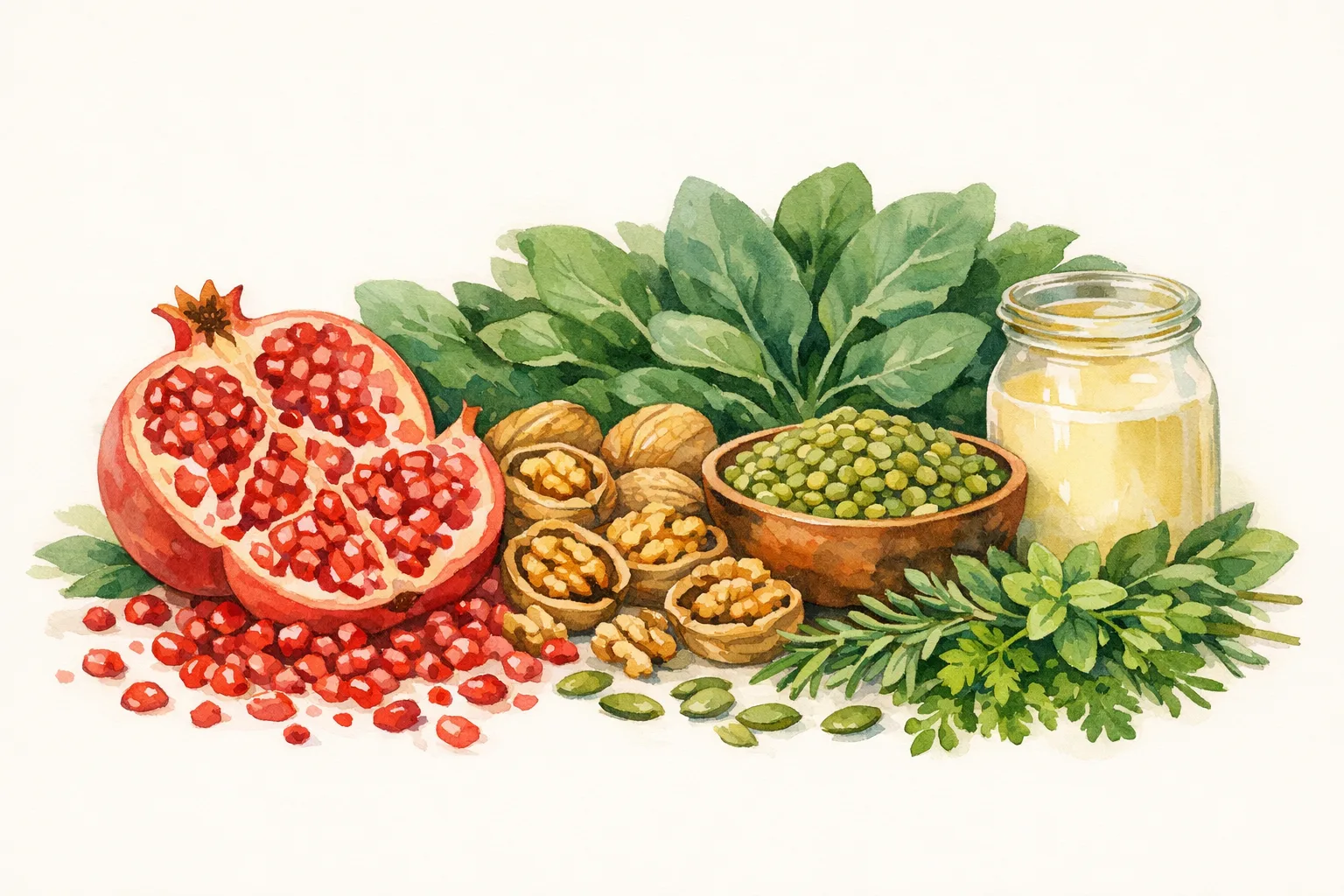
Pomegranate - builds blood quality, supports uterine health. Rich in iron, folate, and antioxidants that protect egg cells.
Walnuts - the highest plant source of omega-3 fatty acids. A meta-analysis in ScienceDirect found omega-3 intake significantly improves pregnancy and fertilization rates.
Saffron - reproductive tonic in Ayurveda. Rich in safranal and crocin, antioxidants that protect egg cells from oxidative damage.
Turmeric with black pepper - anti-inflammatory combination. Black pepper makes turmeric up to 20 times more absorbable.
Dates and figs - rich in iron, magnesium, and natural sugars that nourish reproductive tissue.
Pumpkin seeds - high in zinc, essential for testosterone production and sperm count in men, and for ovulation in women.
Sesame seeds - contain lignans that support healthy estrogen metabolism.
The PCOS Connection
PCOS is a hormonal condition involving insulin resistance and one of the most common causes of fertility problems. A clinical study published in PMC found that a low-glycemic index diet improved insulin sensitivity in women with PCOS. Low-GI foods release sugar slowly: oats, lentils, sweet potato, berries, leafy greens.
Ayurveda identified PCOS as a Kapha imbalance over 3,000 years ago. The Kapha-reducing diet is warm, light, low-sugar, and low-fat - exactly what the research now proves works. Cinnamon has been shown to improve insulin sensitivity. Fenugreek has been shown to improve testosterone and blood sugar regulation. Both have been used in Indian cooking for reproductive health for centuries.
What You Can Do Today
1. Remove trans fats completely. Check every label. If it says "partially hydrogenated," put it back. The Harvard study found trans fat is the single dietary factor most linked to ovulatory infertility.
2. Switch your protein source. Replace meat as your main protein with lentils, beans, and chickpeas. The Harvard study found plant protein strongly associated with lower infertility risk.
3. Add walnuts, pumpkin seeds, and sesame seeds daily. A small handful each. Omega-3s, zinc, lignans - three of the most important nutrients for both egg and sperm quality.
4. Start a warm turmeric drink each morning. Half a teaspoon of turmeric, a pinch of black pepper, warm water or milk. It reduces systemic inflammation.
5. Your partner needs to make these changes too. Sperm makes up half the equation. Every change you make, he makes too.
When to Consider Each Path
Ayurvedic diet and lifestyle changes are the right starting point for most couples. They cost almost nothing, carry no side effects, and improve outcomes whether you conceive naturally or go on to do IVF.
IVF may be the right path if there is a structural issue such as blocked tubes, severe endometriosis, or a very low sperm count that does not respond to dietary changes. The smartest approach: optimize your diet and lifestyle for 90 days first. Then reassess. If you then need IVF, you will walk into that clinic with better egg quality, better sperm, better hormone levels, and a better chance of success.
A systematic review in Cureus found that Ayurvedic management can enhance IVF success rates, especially after previous failed cycles.
The Omioni Approach
At Omioni, we offer Natural IVF - an intensive, in-home program that restructures your entire life around conception. Diet is one piece. But it connects to everything else: your sleep, your environment, your stress levels, your relationship, your digital habits, and what is in your head.
We come to your home. We work with both partners. We do not sell supplements. We rebuild the conditions that make conception possible.
Based in Las Vegas. People relocate here to do this program.
If you are ready to talk, call us at 972-282-3930. No pressure. Just a conversation about where you are and what might actually help.
Frequently Asked Questions
How long does a fertility diet take to work?
The minimum is 90 days. That is how long it takes for a new egg to fully mature and for sperm to complete a full production cycle. You need a sustained 90-day commitment minimum.
Does my partner need to change his diet too?
Yes. A study from Erasmus University found that ultra-processed food intake in men was directly linked to longer time to pregnancy and higher subfertility risk. A clinical trial published in PMC showed Ashwagandha increased sperm count by 167% and sperm motility by 57% in men with low sperm counts over 90 days. Fertility is a team effort.
Can diet help with PCOS?
Yes. The core of PCOS is insulin resistance. A low-glycemic diet - lentils, oats, berries, sweet potato - directly addresses the root cause. A clinical study published in PMC confirmed low-GI diets improve insulin sensitivity in women with PCOS. Ayurvedic herbs like cinnamon and fenugreek have also shown benefits for blood sugar and hormone regulation.
What is Shatavari and should I take it?
Shatavari is an Ayurvedic herb used for women's reproductive health for thousands of years. Research published in Current Nutrition Reports confirms it contains compounds that support hormone balance, including progesterone and estrogen pathways. It is generally considered safe. Talk to a practitioner about dosage before starting.
Does the Mediterranean diet actually help fertility?
Yes. A study from Harokopio University tracked 244 women doing IVF. Women eating the most Mediterranean-style had a live birth rate of 48.8%. Women eating the least had a live birth rate of 26.6%. Same procedure. Nearly double the outcome. The difference was food.
What foods hurt fertility the most?
Trans fats are the single worst food for egg release, according to the Harvard Nurses' Health Study. After that: ultra-processed foods, fast carbohydrates like white bread and sugary drinks, and excess red or processed meat. These drive inflammation, disrupt hormones, and damage both egg and sperm quality.
Is Ayurveda scientifically proven for fertility?
The research base is growing but not yet at the scale of Western pharmaceutical trials. A systematic review in Cureus found promising results across PCOS, tubal issues, and sperm problems. The Ashwagandha research - multiple randomized controlled trials - is among the strongest natural medicine fertility evidence that exists. The evidence is promising and growing, individual herbs like Ashwagandha have strong clinical data, and the overall approach has 5,000 years of practice behind it.
Medical Disclaimer: This article is for educational purposes only and does not constitute medical advice. Fertility challenges can have many causes. Please consult a qualified healthcare provider before making changes to your diet, starting supplements, or stopping any prescribed treatment. Omioni's Natural IVF program is a lifestyle and wellness program, not a medical procedure.