
You have done the tests. The doctor said your hormones are off. Your stress hormone might be high, your egg supply low, your cycle irregular. And now you are sitting at home wondering what to do next.
You are not alone. And this is not the end of your story.
There is a root that has been used in India for thousands of years to help women with exactly this. It is called ashwagandha. Modern science is now studying it - and what the research shows is worth your attention.
Why Hormones Go Wrong in the First Place
Before we talk about ashwagandha, we need to talk about cortisol. Cortisol is your stress hormone. When life is hard, your body makes more of it.
When cortisol stays high for too long, it suppresses a key signal called gonadotropin-releasing hormone, which in turn reduces two hormones essential for ovulation and menstrual regularity - the hormones that tell your ovaries to work.
Your body does not want to grow a baby when it thinks the world is dangerous. So it shuts down your reproductive system. The biology is correct. But for a woman trying to conceive, it is devastating.
What Is Ashwagandha
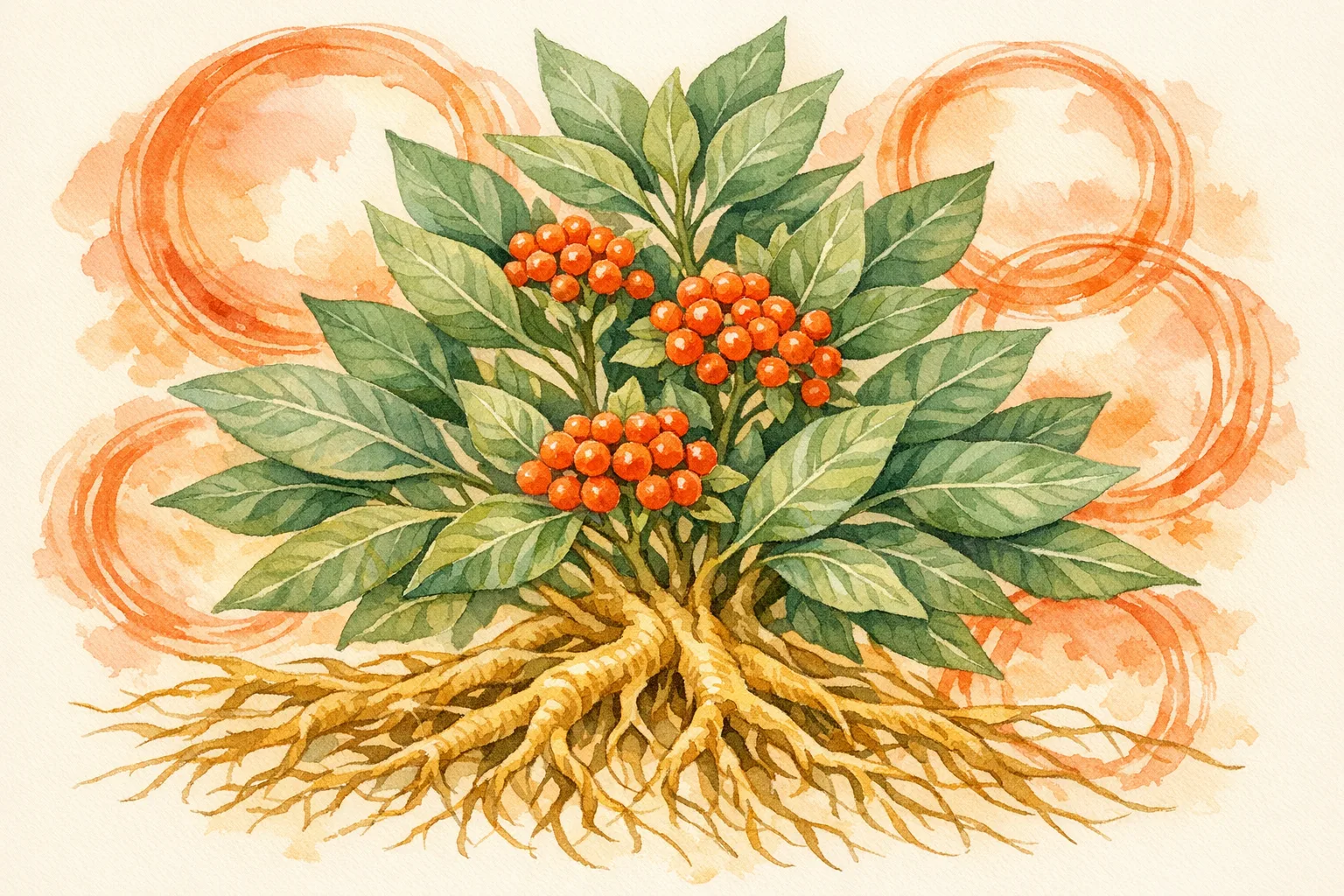
Ashwagandha is a small shrub that grows in India, Africa, and the Middle East. Its scientific name is Withania somnifera. In Ayurvedic medicine - the 5,000-year-old healing system from India - it is classified as a Rasayana: a rejuvenating herb that restores vitality and supports reproduction.
Growing up in Himachal Pradesh, I did not learn about ashwagandha from a supplement bottle. I learned about it from the women in my family, who understood the body as a whole system. Among all my relatives, nobody had problems with pregnancies. The older women in the village were the first consultation. They knew which roots, which foods, which habits kept a woman's body ready for a child.
What the Research Shows
Cortisol Reduction
A randomized controlled trial by Chandrasekhar et al. found that adults taking 300mg of KSM-66 ashwagandha extract twice daily for 60 days experienced a 27.9% reduction in serum cortisol compared to placebo. Participants also reported significant improvements on all stress-assessment scales.
Nearly 28% less cortisol. In 60 days. In a double-blind, placebo-controlled trial. A study by Salve et al. used a similar 60-day protocol with KSM-66 and found comparable reductions in perceived stress and cortisol, lending replication credibility to the Chandrasekhar findings.
Estrogen and Reproductive Hormones in Women
The most important women-specific trial was conducted by Dr. S. Gopal and colleagues and published in the Journal of Obstetrics and Gynaecology Research (PubMed ID: 34553463).
In this 8-week, randomized, double-blind, placebo-controlled study, 100 women with climacteric symptoms were randomly allocated to take either a placebo or 300mg of an ashwagandha root extract twice daily.
Ashwagandha intake demonstrated a statistically significant increase in serum estradiol and a significant reduction in serum follicle-stimulating hormone and serum luteinizing hormone compared with the placebo.
Estradiol went up - the hormone that drives egg development and a healthy uterine lining. The egg-stimulating hormone came down, signaling that the ovaries are responding better and working less desperately.
Stress-Related Menstrual Irregularities
A randomized, double-blind, placebo-controlled trial published in the Journal of Ethnopharmacology enrolled 68 women with stress-related menstrual irregularities. Participants received 300mg of standardized KSM-66 ashwagandha root extract twice daily for 90 days. The intervention group showed statistically significant reductions in the egg-stimulating hormone and normalization of hormone ratios in women with elevated baseline levels suggesting early diminished ovarian reserve.
Elevated egg-stimulating hormone above certain levels in the early follicular phase is used clinically as a marker of diminished ovarian reserve. Even modest reductions in this hormone in this population may reflect improved ovarian responsiveness, though hormone normalization alone does not confirm improved fertility outcomes.
The Thyroid Connection
Many women struggling to conceive have thyroid problems they do not know about. Subclinical thyroid dysfunction is strongly linked to irregular cycles and difficulty conceiving.
Studies prove that active substances from ashwagandha cause an increase in the secretion of thyroid hormones by the thyroid gland and a subsequent decrease in the thyroid-stimulating hormone in accordance with the hypothalamic-pituitary-thyroid axis.
Subclinical hypothyroidism is associated with inability to ovulate, luteal phase defect, and elevated miscarriage risk. Ashwagandha's documented thyroid effects are therefore fertility-relevant.
The Broader Endocrine Picture
Research shows that ashwagandha can have a positive effect on the functioning of the endocrine system, including improving the secretory function of the thyroid gland, normalizing adrenal activity, and multidirectional improvement on functioning of the reproductive system.
How Ashwagandha Actually Works
The active compounds in ashwagandha are called withanolides. They modulate cortisol production and support the stress-response axis.
Withanolides reduce the downstream cortisol response. This restores normal hormonal pulsatility, which allows egg-stimulating and egg-releasing hormones to rise to levels that support follicular development and ovulation. In women with stress-induced hormonal disruption, this mechanism can restore menstrual cycles.
Beyond cortisol modulation, ashwagandha reduces markers of oxidative stress, which can damage ovarian follicles and impair egg quality.
Conventional vs Natural - An Honest Comparison
IVF is a real option for many women. For some, it is the right option.
According to data from the U.S. Centers for Disease Control and the Society for Assisted Reproductive Technology, a 30-year-old might have a 50% chance per IVF cycle, while a 42-year-old using her own eggs typically has about a 10-15% success rate per cycle.
For women with low egg reserve, the numbers are harder. IVF cycles with very low egg reserve levels showed more than a fivefold greater cancellation rate, a two-fold lower live birth rate per cycle, and a 4.5-fold lower rate of frozen embryos available.
A study published in a Middle East Fertility Society Journal found a live birth rate of 30.4% in women with normal egg reserve levels compared to 14.7% in all women with low egg reserve levels.
Most IVF cycles cost $12,000 to $15,000 per attempt, often without insurance coverage, and many women need multiple cycles.
The Ayurvedic approach works from the inside out. It does not stimulate eggs artificially. It restores the hormonal environment so your body can do what it was designed to do. For many women, building that foundation first changes everything.
| Factor | IVF | Ayurvedic Hormonal Support |
|---|---|---|
| How it works | Stimulates eggs externally with injections | Restores hormonal environment naturally |
| Cortisol impact | Does not address root stress cause | Reduces cortisol by up to 28% (Chandrasekhar 2012) |
| Estrogen effects | Synthetic hormone management | Significant increase in natural estradiol (Gopal et al.) |
| Timeline | One cycle: 4-6 weeks | Hormonal shifts visible at 60-90 days |
| Side effects | Bloating, mood shifts, OHSS risk | Mild GI upset in some; generally well tolerated |
| Suitable during pregnancy | Monitored medical process | Stop ashwagandha once pregnant; consult provider |
The Ayurvedic Approach
Ashwagandha is not a single pill that fixes everything. In Ayurveda, it is one piece of a full system - combined with food, sleep, movement, reduced toxic load, and a calm nervous system.
Ayurvedic practitioners have combined ashwagandha with other reproductive herbs for centuries. A recent randomized controlled trial found that combining ashwagandha with Shatavari - another Ayurvedic root used for female reproductive support - showed promising results for managing hormonal symptoms, with the combination outperforming either herb alone.
At Omioni, the herb is one layer. The diet is another. The stress removal is another. The removal of what disrupts your body - phone placement, environmental toxins, relational stress - is another.
What You Can Do Starting Today
1. Get your hormone levels tested. Ask your doctor for a panel that includes cortisol, estradiol, the egg-stimulating hormone, and the egg-releasing hormone. Also ask for your anti-Mullerian hormone level - this measures your remaining egg supply.
2. Look at your stress load honestly. If you are running on adrenaline every day, your body has already decided not to conceive. That has to change first.
3. If you consider ashwagandha, choose the right form. KSM-66 is the most researched form. Take it consistently at the studied dose of 300 to 600mg daily, and give it at least four to eight weeks to take effect.
4. Stop ashwagandha once you are pregnant. Ashwagandha should not be used during pregnancy due to the risk of miscarriage, premature delivery, and possible harm to the fetus.
5. Do not take it if you have thyroid overactivity. Women with hyperthyroidism or Graves' disease should avoid ashwagandha, as it may worsen thyroid overactivity.
6. Read about what a full Ayurvedic fertility protocol looks like. Ashwagandha is the beginning. See our article on building an Ayurvedic fertility protocol from the ground up.
When to Try This Path First - and When to Go Straight to IVF
If you are under 38, your hormone disruption appears stress-related, your cycles are irregular but not absent, and you have not yet tried a structured natural protocol - the research suggests there is real value in a 90-day natural approach before moving to IVF.
Ninety days is roughly the time it takes for an egg to develop from its earliest stage to ovulation. What you eat, how you sleep, how your body handles stress affects the egg that may become your baby.
If you are over 40, if your egg supply is severely diminished, if there are structural issues like blocked tubes, IVF may be the right first step.
For more on how Ayurvedic approaches compare to conventional treatment, see our article on natural fertility versus conventional IVF - what the numbers actually mean.
A Word About Safety and Limitations
The research on ashwagandha for women is real - but it is not complete. Most of the strongest clinical trials are small. Limitations in existing studies - such as small sample sizes - underscore the need for more rigorous, dose-responsive research.
Ashwagandha appears to be well tolerated for up to 3 months of use. Beyond that, more caution is warranted. For women with stress-related hormonal disruption, it is a well-tolerated, evidence-informed tool - and like all tools, it works best as part of a complete approach.
Ready to Talk
Omioni offers a complete, in-home natural fertility program built on Ayurvedic principles and modern research. We come to where you live. We restructure the environment, the food, the stress, the habits - everything that affects your body's readiness to conceive.
Based in Las Vegas. People travel here to work with us.
Call 972-282-3930 to start the conversation. You can also read more at how Omioni works.
Frequently Asked Questions
How long does ashwagandha take to affect hormone levels?
Meaningful hormonal changes appear at 60 to 90 days of consistent use. The Chandrasekhar cortisol study showed significant results at 60 days. The Gopal hormone study ran for 8 weeks. Give it at least two months before assessing results.
Which form of ashwagandha is best for hormone balance?
Root extract standardized to 5% withanolides is the most commonly studied form and the one used in clinical trials. Look for KSM-66 specifically - it has the largest body of published human research behind it.
Can ashwagandha help with PCOS?
The reduction in cortisol levels, the ability to regulate gonadotropins, and the enhancement of steroidogenesis make it a candidate for women with fertility issues and gynecological disorders related to polycystic ovary syndrome. However, PCOS has multiple subtypes, and ashwagandha alone is not sufficient. A complete hormonal assessment and full lifestyle protocol are needed.
Is ashwagandha safe to take while trying to conceive?
The research suggests ashwagandha is generally safe for use in the pre-conception period. Stop taking it as soon as you get a positive pregnancy test due to the risk of miscarriage or premature delivery. Always tell your healthcare provider what supplements you are taking.
Can ashwagandha replace IVF?
No. Ashwagandha addresses hormonal disruption and stress-related suppression of ovulation. IVF addresses structural issues, severe egg scarcity, and other conditions that natural approaches cannot fix. The right path depends on your specific situation.
What dose of ashwagandha is used in the fertility studies?
Most clinical trials used 300mg of standardized ashwagandha root extract twice daily - 600mg total per day. Generic root powder requires higher doses because it contains lower and more variable concentrations of withanolides. Standardized extract is more reliable.
Are there women who should not take ashwagandha?
Yes. Women who are pregnant or breastfeeding should avoid it. Women with thyroid overactivity or Graves' disease should avoid it. Women on blood pressure medication should consult their doctor first. Common side effects are mild and include stomach upset, loose stools, nausea, and drowsiness.
Medical Disclaimer: This article is for informational purposes only and does not constitute medical advice. The information here is not intended to diagnose, treat, cure, or prevent any disease or health condition. Always consult a qualified healthcare provider before starting any supplement or making changes to your fertility treatment plan. Ashwagandha should not be used during pregnancy or breastfeeding without guidance from a licensed medical professional.