
You are lying awake at night running numbers. Another cycle failed. Another $20,000 gone. A friend texts you that castor oil packs changed her life. You open Google at 2am.
The honest answer: castor oil is not a proven fertility treatment. But the biology behind it is real. And within a broader Ayurvedic protocol, the evidence is worth taking seriously.
What Castor Oil Actually Is
Castor oil comes from the seeds of the Ricinus communis plant. Ancient Egyptian papyrus records document its use. Ayurvedic texts reference it going back to at least 2000 BC.
The active compound is ricinoleic acid. It makes up roughly 90% of castor oil's fatty acid profile. Cold-pressed extraction keeps this compound at its highest concentration.
The FDA has approved castor oil for one use: as a stimulant laxative. Everything else - including fertility - sits outside that approval.
What the Research Shows
There are three bodies of evidence relevant to castor oil and fertility. Two involve laboratory and pharmacological research. One involves a small clinical study. None are large fertility-specific trials.
The Grady Immunomodulation Study (Journal of Naturopathic Medicine, 7:1, 1998)
Researcher Harvey Grady ran a double-blind study with 36 healthy subjects. He measured lymphocyte values before and after topical castor oil pack application. The castor oil group showed a significant increase in total lymphocyte counts and T-11 cell counts within 24 hours. The control group showed no meaningful change. The p-value was 0.01.
T-11 cells are immune cells that help the body fight viruses, bacteria, and fungi. An increase in T-11 cells means the immune system moved into a more active state. Whether that state improves fertility has not been studied directly.
36 subjects is a starting point, not a conclusion. Larger trials have not been done.
The Tunaru Prostaglandin Study (PNAS, 2012 - PubMed ID: 22615395)
Dr. Sorin Tunaru and colleagues confirmed that ricinoleic acid activates prostaglandin EP3 receptors in both intestinal and uterine smooth muscle cells. That explains why castor oil has historically been used to stimulate labor. A separate review published in Evidence-Based Integrative Medicine (Mein et al., 2005) confirmed that transdermal absorption of castor oil does occur.
Whether applying castor oil to the abdomen before pregnancy improves conception rates has not been studied in a controlled trial.
The Anti-Inflammatory Evidence
A pharmacological review by Vieira et al. published in Mediators of Inflammation (2000) confirmed that ricinoleic acid exerts measurable anti-inflammatory effects. The mechanism resembles that of capsaicin - acting on sensory nerve pathways to reduce inflammatory signaling.
Chronic low-grade inflammation is a documented factor in endometriosis and polycystic ovary syndrome. The theoretical connection between castor oil's anti-inflammatory action and these conditions is logical. No clinical trial has confirmed the connection for fertility outcomes.
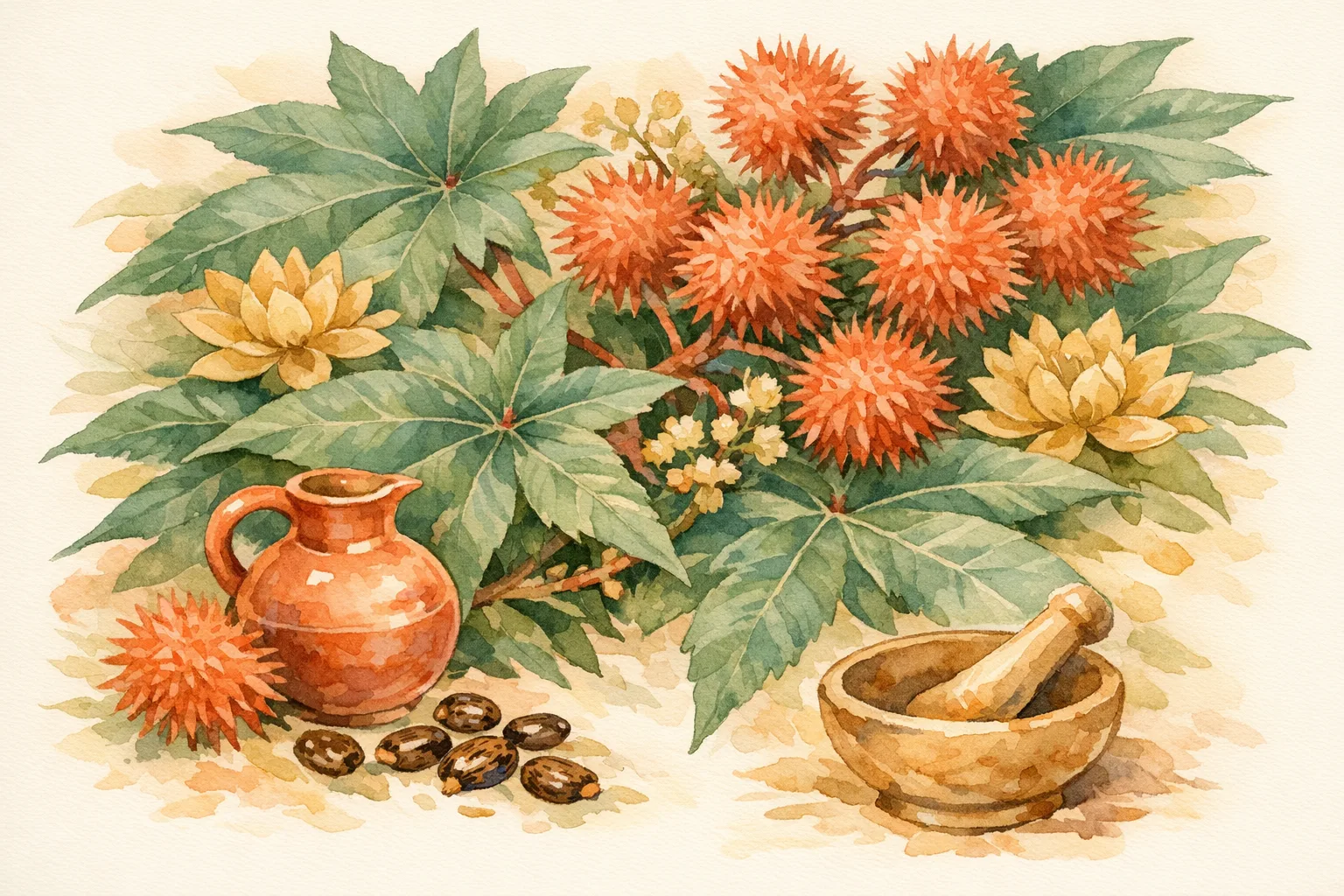
The Ayurvedic View - Eranda Taila
In Ayurveda, castor oil is called Eranda Taila or Gandharvahasta. A comprehensive review published in Ayushdhara (2018) describes it as a primary agent in Virechana karma (purgative therapy) and Snehana karma (oleation therapy) within the Panchakarma system.
Ayurvedic texts describe Eranda as targeting the pelvic area, the reproductive tract, and the colon. The 2018 Ayushdhara review classifies it as "Adhobhaga doshahara" - meaning it clears disorders of the lower body - mapping directly onto uterine and ovarian health.
A case report published in PMC (PMID: 10477795) documented Eranda Taila Matra Basti stimulating uterine contractions via ricinoleic acid activating prostaglandin EP3 receptors in uterine myometrium - the same pathway Tunaru found in 2012.
Ayurvedic tradition describes castor oil as detoxifying the reproductive tract, reducing Vata imbalance in the pelvic region, and supporting Artava (female reproductive tissue). These are traditional claims with biological plausibility. They are not proven by fertility-specific clinical trials.
Conventional vs Natural Approaches
| Factor | IVF (Low AMH) | Ayurvedic Protocol |
|---|---|---|
| Success rate per cycle | 9.5-20.5% | 84% conceived within 12 cycles (Inito study) |
| Cumulative success (5-6 cycles) | ~20% (PLOS One, 769 cycles) | Studies limited; larger trials needed |
| Cost | $19,000-$30,000 per cycle; $100,000-$180,000+ over 5-6 cycles | Call 972-282-3930 for program details |
| Insurance coverage | 85% out of pocket; only 25% of Americans have any coverage | Not covered; call for pricing |
| Dropout rate | 35% quit due to emotional/physical stress | Not studied formally |
| Invasiveness | High - injections, retrieval, transfer | None - entirely non-invasive |
| Natural conception afterward | 17-24% of couples told they need IVF conceive naturally | The goal of the protocol |

The Ayurvedic Castor Oil Protocol
Castor oil is one tool in a broader plan. It does not work in isolation.
Castor Oil Packs - Follicular Phase Only
Apply a flannel or cotton cloth soaked in cold-pressed, organic castor oil to the lower abdomen. Cover with a clean towel. Apply gentle heat from a warm water bottle or heating pad on a low setting. Hold for 30-60 minutes. Do this 3-4 times per week.
Use castor oil packs during the follicular phase only - from the end of your period to ovulation. Stop completely once ovulation occurs. Do not use castor oil packs during pregnancy, menstruation, or if you have active skin irritation. If you are in an active IVF cycle, do not use packs without your doctor's approval.
Internal Use - Only Under Supervision
Ayurvedic practitioners sometimes recommend small oral doses of castor oil for Vata-related conditions. These should only be used under supervision of a qualified Ayurvedic practitioner. Internal use should be avoided during pregnancy.
Where It Fits in a Broader Protocol
At Omioni, castor oil packs are one small piece of a larger program that addresses diet, stress, sleep, environment, and relationship dynamics. The Inito study's 84% conception rate within 12 cycles came from a targeted holistic protocol, not from one tool in isolation.
For more on what a complete Ayurvedic fertility protocol looks like, see our article on the full Ayurvedic fertility protocol and our breakdown of natural approaches for low AMH.
What You Can Do Today
Buy cold-pressed, organic castor oil and an undyed cotton or wool flannel cloth. Start packs on day 5 of your cycle. Do 3 sessions in the first week.
Track your cycle. Use basal body temperature or an ovulation predictor kit to confirm when you ovulate. Stop packs the day ovulation is confirmed. Resume next cycle on day 5.
Do not use this as a replacement for medical evaluation. Get your AMH level tested. Get a baseline ultrasound. Understand what you are working with before designing any protocol.

When to Consider Each Path
Castor oil packs make sense as part of a natural protocol if you are under 38, have been trying for under 12 months, have no blocked tubes, and have not been diagnosed with severe male factor infertility. They are low-risk and low-cost.
IVF makes sense when tubes are blocked, when there is severe sperm factor, or when multiple natural cycles with comprehensive support have not resulted in pregnancy. IVF is expensive, physically demanding, and has a 35% dropout rate due to emotional toll.
17-24% of couples told they need IVF conceive naturally. A three-month Ayurvedic protocol costs a fraction of one IVF cycle. The data suggests it is worth trying first for the right patient profile.
Limitations - What We Do Not Know
There are no randomized controlled trials specifically testing castor oil packs for fertility outcomes. The Grady study measured immune markers, not conception rates. The Tunaru study confirmed uterine receptor activation, not pregnancy rates. The transdermal absorption study confirmed the oil gets through skin, not that it reaches the uterus in meaningful concentrations.
The Inito study's 84% conception rate has not been independently replicated in a large trial. Most evidence is either mechanistic (plausible but not proven) or anecdotal (interesting but not scientific).
Larger trials are needed. They have not been funded, largely because castor oil cannot be patented.